
I still remember a scene from my early days in radio. One of my first shows. Saturday, a self-op studio, me running the board alone, and I was itching to do a great show. Some of it I had prepared well. For the rest I told myself: I want to come across as authentic, so I’ll open the mic whenever I feel it fits the flow of the music. After the show I felt great. I thought: I’m a terrific host.
Then came Monday. My boss called me into his office and asked what exactly I thought I had been doing in there. It was, and I quote (radio language was rougher back then than it is today), “programming terrorism.” I had wrecked the music flow, interrupted listeners far too often while they were trying to enjoy a song, talked far too much. And by the end, he said, I had been almost impossible to follow.
But we also made an agreement. We would work on the strengths of the host Stefan Margenfeld, and less on his habit of following every impulse. Because there is a big difference between sincerity and authenticity. In public, we only really want to show one particular facet of ourselves, so that we have any chance at all of being understood by the listener.
That was a lesson for me. About self-image and how others see you, too. Authenticity is not walking in and doing things completely unsteered, then feeling good afterwards that so much of it was unprepared. Authenticity is the deliberate repetition of things that seem plausible to the listener in the context in which I say them.
That Monday, I didn’t really understand what my boss meant when he said: You have good qualities as a host. We want to work on those. We want to show them more often. Because that’s you.
Today I know what he meant. He didn’t mean: we want the real Stefan. He meant: we want the part of you that can carry a show. We’ll repeat it until the audience recognizes it, and through it, you.
That was my first practical lesson in how public authenticity works. You can take it apart with the tools of media criticism. But it was an issue in professional communication for a long time, and it still is. And it has a great deal to do with what we are currently debating under the heading of AI and authenticity.
The debate we’re having is the wrong one
For a few years now there has been an outright culture war. Real versus fake. AI makes pictures that aren’t pictures. Voices ring out that aren’t human voices at all, only machine ones. Texts meant to sound human that nobody wrote by hand.
Miles of articles pour out about how often you’re still allowed to use a dash, or how many direct comparisons you can make, because all of that now supposedly marks a text as machine-made. Apparently it matters a great deal to us that we aren’t mistaken for a machine, and that the craft keeps showing.
I find these reactions understandable. Still, I think the whole debate is built wrong. It only works if we assume that everything before AI was real. That there was a Before in which pictures were still truth, texts were still truth and voices were entirely unmediated. As if there had once been a natural state of media.
I don’t think there ever was.
Every photo is a selection. Where the camera stands, when the shutter clicks, what goes into the frame and what stays out: those are the photographer’s decisions. And choosing the image is the editors’ decision. Staging is staging, whether I see it in a commercial or read it in a newspaper feature. It is always subject to a journalist’s selection. You learn that in your journalism traineeship, by the way: objectivity in journalism is really an illusion, because we preselect everything under certain conditions before we present it to an audience.
Deep down we always knew this. The media criticism isn’t new either. We just managed to push it aside for a long time, because pushing it aside is more comfortable than thinking it through.
What is changing now with AI, though, isn’t simply “more of the same.” It is something qualitatively new. A newspaper selects, true, but it doesn’t invent events. A photo is a composition, true, but it shows something that was there. With AI, that basic premise falls away. What is made becomes scalable, and it becomes finely steerable. And, unlike anything before it, it can be produced without an event. Something tears that mostly held until now: the link between how something looks and where it comes from. A photo looked like a photo because I could rightly assume there had been a camera, and a real person in front of it. A voice was a real person’s voice because someone must have spoken it, or I wouldn’t be hearing it.
That was never a guarantee. But it was a plausible assumption. And that assumption no longer holds.
Three meanings of “real”
If you take this debate seriously, a distinction helps. What actually is real? When people say “real,” they usually mean one of three different dimensions. And they switch between them constantly without noticing.
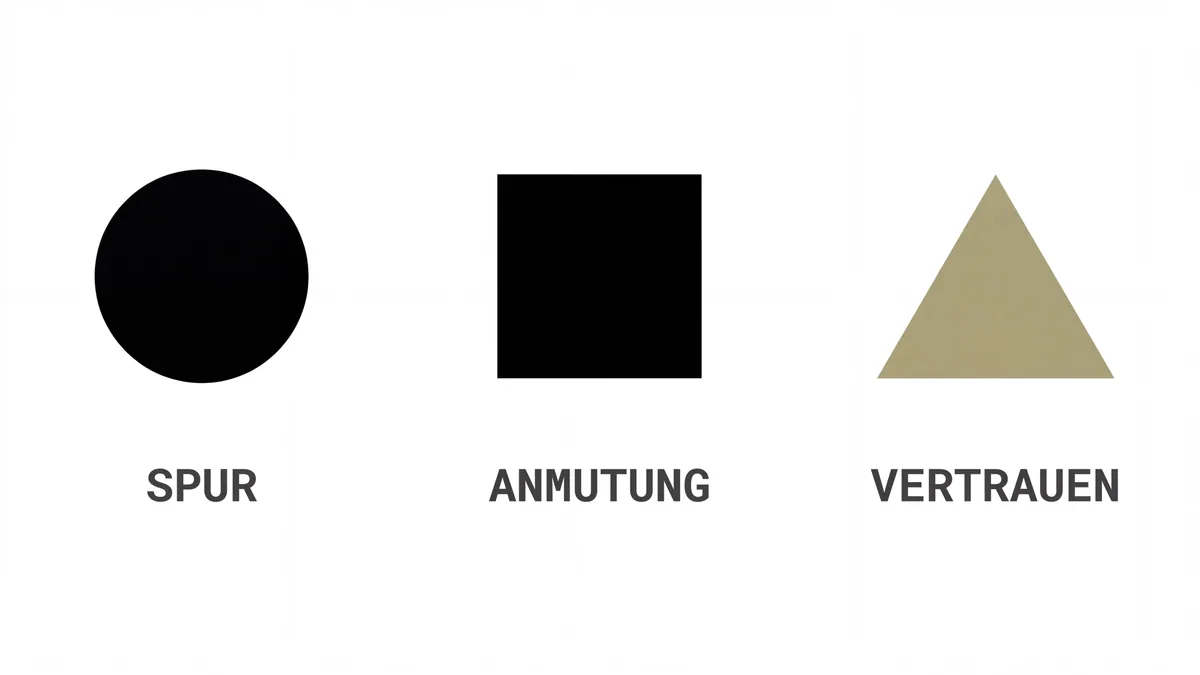
The first is the trace. An event inscribed itself causally into the medium. Light fell on a sensor, sound reached a microphone, something real left a physical imprint.
The second is the appearance. It looks realistic, it looks as if something happened. Whether anything actually did happen is a separate matter.
The third is trust. Who made this? With what intention? By what standards? Under what social contract with the audience did it come about?
Until recently we could rely on a shortcut: if the appearance was right, there was probably a trace as well. That shortcut was never precise, but in everyday life it was usually good enough. With AI it isn’t anymore. Appearance is now available at the push of a button, by prompt. That devalues the trace as a source of trust.
What remains is the third, and this matters a great deal: trust. It takes more work than the shortcut. But it is what credibility always rested on in the first place.
Authenticity, understood this way, is rarely a property of the content. It is a property of the relationship between source, context and expectation.
What radio, voice work and marketing teach about crafted authenticity
For more than 20 years I have worked in rooms where authenticity was made. Made, mind you. Never faked.
On the radio I was a personality. And that personality came about, plain and simple, through repetition. Whatever worked with the audience, we stabilized. Whatever didn’t was quietly set aside. What came out of it was a recurring slice of a person behind the microphone, something the audience could orient itself by. Unfiltered it was not. Was it real? In the sense of unmediated: no. In the sense of consistent, reliable, recognizable: absolutely.
In voice work I learned that a brand has a sound, and someone has to decide what it is. The client says how they want to sound. Warmer or more distant. More authoritative or more collegial. Calm or forward-leaning. Direction shapes the performance. “Real” is almost always the desired result here; everything is supposed to sound real. But that never meant some true inner core the voice actor had to lay bare. I don’t say that cynically. It is one of the core skills of the trade: to simulate authenticity as closely and believably as possible for the listener. And it is crucial for a brand, too, to decide how it wants to sound, look and come across. To not leave its effect to chance.
In marketing and communications leadership, where I work today, authenticity is secondary. My main currency is congruence. There is the philosophy of a company, there is its brand facing outward, and there is how it is perceived by its audience, or, more precisely, by its various stakeholders. These three levels have to fit together.
When they drift apart, the result isn’t necessarily inauthenticity. It may even be the more authentic state, because all of us drift in what we think over the course of a life. Hardly anyone I know holds the same views as an adult as they did as a child. But in a corporate context, and especially in marketing communication, that divergence can breed mistrust. And mistrust is the most expensive currency a brand can know. Mistrust is the hardest thing that can happen to a brand.
From these three experiences I draw one conclusion. Public authenticity is almost never a natural state. It is a stabilized format. A discipline. A deliberate narrowing of what you show of yourself, and how you show it. Once you have understood that, you stop letting the AI debate throw you off balance.
Why truth often just feels easy
There is one point in this whole debate that I consider very important, and that gets far too little attention.
When something reads smoothly or looks visually plausible, we are quicker to credit it with truth. What is easy to process simply feels truer to us. Cognitive psychology calls this processing fluency. And there is a second effect, the illusory truth effect: the more often we hear something, the more likely we are to believe it. Regardless of whether it is true. Both have been well documented for decades.
That is already a problem in ordinary media life. With AI it becomes a structural one. Because AI scales more than content. It scales plausibility. Above all through automation. I can repeat things endlessly; I can come up with one idea and place it and spread it, over and over.
At the push of a button, AI produces exactly the smooth, instantly digestible appearances that our brains read as a signal of truth. An AI writes text so that I can read it as easily as possible. An AI image slots in seamlessly. AI audio sounds round.
And we take that ease of consumption as evidence. Of truth. Of authenticity. Anyone who wants to communicate seriously in the coming years has to understand this. Otherwise they are working against brains that sided with the machine long ago, without their owners being aware of it.
My position: AI-friendly, but not arbitrary
I am clear on this. I consider AI one of the most exciting tool developments of our time. A curated content pipeline, run through with human judgment and using AI as its engine, isn’t fake. It is professional.
But here is the point I consider decisive: AI is only used professionally when stance, standards and responsibility come before the output.
“Truly fake” doesn’t begin where an AI is involved. It begins where arbitrariness moves in. Where I just let the output happen, with no deeper perspective, without having made a selection, without anyone holding the pen in case someone needs to step in.
A brand that lets its AI pipeline run without first working out what its voice actually is won’t be exposed because the audience spots the AI. It will simply become interchangeable. Strategic communication has to come before the pipeline. It defines what our perspective is in the first place, which standards apply, which repetitions actually create recognition, and above all: recognition for what.
That applies to me too, by the way. Anyone in this field who recommends AI pipelines without first settling the strategic question is part of the problem.
Case by case instead of a blanket rule
I don’t exempt myself from this debate. In many places I run up against my own limits. I wrestle just as much with the question of where AI is allowed into a project and where it isn’t. And I notice that it can’t be answered across the board. Sometimes it gets very granular.
An example. When I need an image for an article (a metaphor, something atmospheric, something that illustrates an idea), AI is allowed in. That is a tool. A consistency tool, even. This used to be a different territory: stock photography. I had to retouch by hand to put a product on a desk. That is less and less necessary. The result is simply closer to what I actually want to say.
But. When it comes to people. When I show a testimonial, for example: a person looking straight into the camera and telling of an experience that I, as the communicator, mean to come across as positive. That person has to be real.
The labeling requirement has nothing to do with it. The statement itself would otherwise be empty. A testimonial claims an experience. If that experience never happened, then it isn’t just the image that is “AI-generated.” The whole statement is hollow, whether I label it or not. Here the trace, in the sense of the three dimensions from earlier, isn’t carrying a detail. It is carrying the entire message.
For me this is not a gut decision. It is a question I check against the company’s philosophy. What fits what a brand stands for, and what doesn’t? And that check has to come before every single decision. Not once the image or the video is already finished.
That is more work than a blanket rule. But blanket rules for AI, especially in communication, are almost always wrong. Either they are too narrow and block sensible uses. Or they are too broad and let in an arbitrariness that has nothing to do with what the brand actually wants to say.
Granular means thinking through each use on its own. With one question in the back of your mind: What would it mean if someone knew? If I used AI at this point, is that in line with what I claim to be? Or is there a break?
And then there is the other side. There are areas where I trust AI even more than people. That sounds surprising at first. It really isn’t.
Take product images, packshots, texts with clear specifications. Wherever I can set precise standards, a machine has the edge. It can enforce standards consistently and without emotion. A machine doesn’t tire. It doesn’t suddenly turn creative where consistency was called for, provided I have set it up properly beforehand. It doesn’t deviate because it fancies a change today. People do, and that is usually a good thing. But in some places it is exactly the problem for a brand.
Semantic precision in the details is another story. Hallucinations, label accuracy, fidelity to detail: an AI will quickly turn a product name into something that resembles it but is wrong. That still needs checking. That still needs correction loops. But as a principle, structurally repetitive tasks are the machine’s home game.
That also changes the question of where AI is allowed in. Machine versus human is too coarse. The real question is: in what mode does the thing we are making work? Is it about consistency and standards? Then machine, by all means. Is it about trace, relationship, credible experience? Then I need a person. And in most cases the two work together. The machine supplies the variant. The person makes the decision.
A model that helps
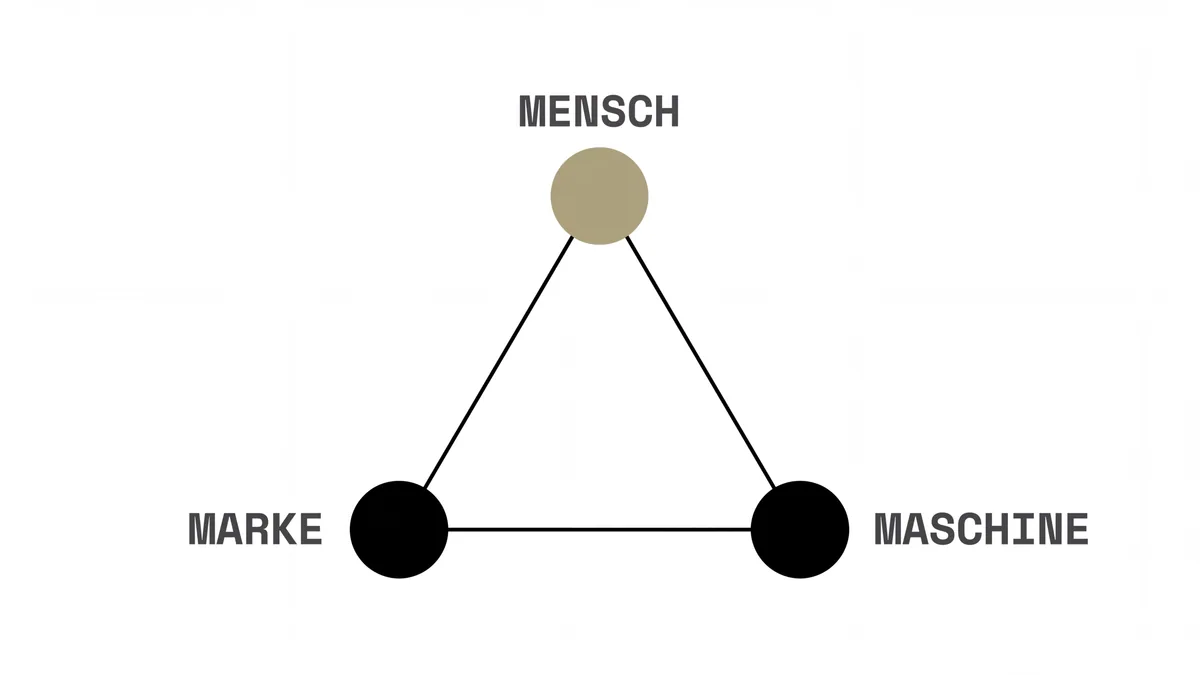
In practice I work with a simple three-way division. People. Brands. Machines.
People carry the voice, the stance, the limits. And they carry the responsibility. It has to be clear who reviews and who signs off. That can’t be delegated.
The brand sets the standards. How we sound. How we look. What we claim, and what we only suspect. These standards aren’t a matter of taste. They are the condition that keeps artificial intelligence from drifting into arbitrariness.
The machine supplies speed. And it can help us be consistent. It processes briefings, produces variants, translates between formats, lays different layers over my output. It can do all that faster than any person could. But at its core it can’t decide where to go. That is where we have to step in as humans. That is where we curate. That is where we check.
Direction stays human. Speed is the machine’s domain.
What we can actually do
Part of the answer lies in better traceability, more than in better detection algorithms. The European Union is already doing quite a lot here. From August 2026, Article 50 of the EU AI Act sets binding labeling requirements, above all for AI-generated deepfakes and for AI-written texts on matters of public interest. There is one important exception: when AI texts go through human editorial review and a person bears editorial responsibility, the labeling requirement for those texts falls away. That protects journalistic work, but it has an uncomfortable consequence. In practice, many cases that would require labeling can be routed around through an editorial loop.
In parallel there are technical initiatives, above all the C2PA standard with its Content Credentials, a kind of nutrition label for media that carries origin and editing steps along with the file. LinkedIn has already announced support; other platforms are looking at similar approaches.
That is no cure. But it is the right direction. It moves the question away from the pixel and toward the process. And it turns “real or fake” back into what it always was: a question of standards and trust.
AI isn’t destroying authenticity. It’s destroying our comfort.
When I pull all of this together, I land on a sentence that won’t let go of me this month.
AI isn’t destroying the authenticity of images. It’s destroying our comfortable habit of assuming images are authentic.
For a long time we could rely on that mental shortcut. Looks real, so it probably is. Sounds human, so there’s probably a human behind it. The shortcut was never truly reliable. But in everyday life it was usually enough.
It isn’t anymore.
And for all the unease, that isn’t really bad news. It is an invitation. To organize trust again where it belongs. Away from the pixel, back to the people and brands who work with pixels. To standards. To responsibility. To relationships.
Images were never real. They were credible as long as we knew the rules. The rules are changing right now. Anyone hoping the old ones still apply is looking in the wrong place.