
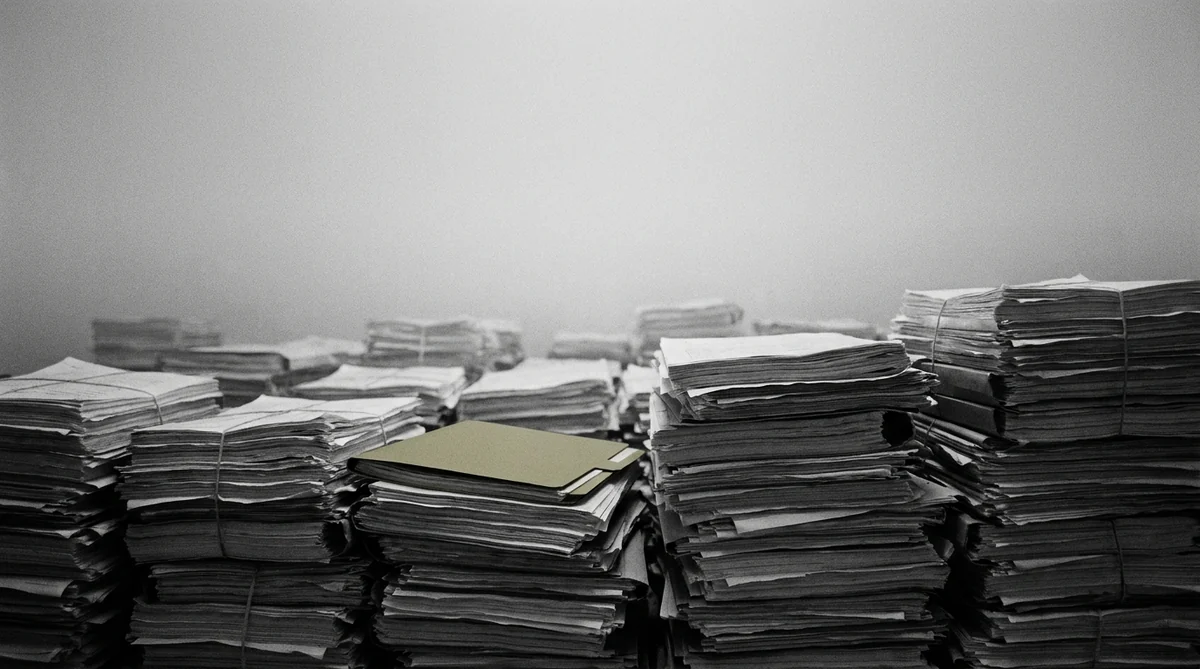
What do you do with six perfect documents?
Picture a division head. Monday morning, first coffee, inbox. Three concepts, two slide decks, one strategy paper. All written over the weekend, all neatly structured, all in the right tone. She has two hours and has to decide which of these documents goes to the board. And she realizes that the question she has trained her whole working life, “Is this well made?”, no longer helps. It’s all well made.
AI makes documents easy. That’s not a small efficiency upgrade. It’s a revolution in production, at least for everything made of text, slides and images. Much of it now gets made in minutes. So the question is no longer whether we can produce content. It’s what happens when production costs almost nothing.
The document had a cost floor
A document was never proof of truth. Inflated papers, slides without substance, reports written for the shelf: all of that existed long before AI. There never was a golden age of documents.
But a document had a cost floor. Whoever handed in ten pages had invested hours at the very least, and those hours filtered. Not perfectly, but noticeably. Something had to be there: research, alignment, experience, craft. Otherwise the paper wouldn’t exist.
That floor is dissolving. A document is more and more often just a trace of a prompt, a model, an output. That shifts three things at once. Volume: more gets made than organizations can process. Credibility: the link between text and expertise weakens. And the quality of decisions: when everything sounds plausible, choosing gets harder than creating.
When text gets cheap, scarcity moves
Expensive in relative terms. Getting hold of evidence doesn’t get harder. What gets scarcer and more valuable is whatever can’t be produced at the push of a button. I want to stay sober about this. Information overload has been described for decades, long before language models. AI didn’t invent the overload. It speeds up a system that already sends too much and digests too little.
Where this is heading, I see in many conversations across professions: “Show me, don’t tell me” as the standard. Examples, data, artifacts, real decisions. Origin becomes a signal. What is source, what is interpretation, what is synthesis? And then the question no model answers: who stands behind the statement, and who bears the consequences?
Plausibility smog
There’s an uncomfortable point on top of that. Language models can phrase things convincingly even when the content is wrong. A study from the University of Zurich found that participants actually rated AI-generated misinformation as accurate more often than misinformation written by humans. That’s one finding, not a law of nature. But it hits a nerve.
This is plausibility smog: an environment in which everything sounds good, and nobody can smell anymore where it comes from. It turns “sounds good” into a poor quality criterion. In that kind of environment, evidence, marking uncertainty and review routines become the real lever for productivity. Not as bureaucracy. As protection.
Curation becomes a leadership task
When production costs almost nothing, something else becomes scarce: attention. Trust. Relevance.
That makes curation a leadership task. It can no longer be delegated away. Curating means leaving things out. It means having criteria: what has to be backed by evidence, what has to have been lived? And it means sending less, so that more arrives. There is a limit to this. It doesn’t apply to documents whose length is their function: contracts, safety documentation, compliance. It applies to everything that is sent only for the sake of having sent it.

My thesis: AI doesn’t just speed up the production of documents. It devalues the document as a signal. The future belongs to those who select, give reasons and stand behind what they chose. And maybe this is the question that really helps the division head on Monday morning: who stands behind this?